Everywhere and Nowhere: The Truth About Belonging
How cinema, markets, festivals, and memory reveal the beauty of identity, difference, and connection.
Written by Yasmin Shaheen-Zaffar 26th August 2025 Copyright 2025
Bank holidays have a way of drawing people together – strangers, friends, families, whole cities. This Bank holiday for me was no different.
From an outdoor cinema at Ilkley Lido, to Northern Day in Bradford, to the streets Leeds Festival, I found myself moving through spaces that asked the same quiet question: where do we belong?
Belonging is both universal and deeply personal. It can be felt in the laughter of strangers, in the taste of familiar foods, in the rhythm of a crowd, or in the memory of childhood streets.
And yet, it can also feel elusive – especially if, like me, you know what it is to sometimes feel out of step with the world, to experience the difference of being neurodivergent.
Belonging can be fragile, but when it comes, it often arrives in the most surprising places.
Cinema Under the Sky
On a Saturday evening, I found myself at Ilkley Lido, sitting beneath the open sky, watching an outdoor screening of Sexy Beast. The backdrop was surreal – rolling hills, sheep grazing in the distance, and a sea of strangers huddled together in deckchairs.
I’d brought a picnic for two, aubergine curry made at home with fresh local ingredients. Around me, I chatted to strangers excitedly about the film, and the “fortune teller” character drew bursts of laughter.
At first, though, there was a slight hesitancy among those who arrived early. I was first in the queue – getting the times wrong. People shuffled in with their blankets and folding chairs, scanning the space, a little suspicious, a little unsure at first.
Am I going to look weird talking to strangers – that kinda vibe.
But as the evening darkened, hesitation gave way to conversation. Laughter spread – I had the confidence to share my home-made food with a total stranger.
And all the while, on screen, Gal Dove was wrestling with his own questions of belonging.
Could he stay in the warmth and safety of his new life, or would the violent past come knocking and pull him back into a toxic kind of “family”? Sexy Beast isn’t just a gangster film – it’s a parable about how hard it is to break away from the places we no longer belong, and how fragile yet precious yet difficult it feels to choose peace, love, and connection instead.
What began as a cautious gathering became a collective moment. Belonging doesn’t always announce itself loudly. Sometimes it’s as simple as showing up, eating together, and watching a story unfold beneath the same stars – stories that remind us that finding where we belong often means daring to break away from where we don’t.
Northern Day at Daley Market
That same pattern unfolded at Northern Day in Bradford’s newly refurbed Daley market. At first, people hovered near the edges of food stalls, weighing their choices, holding back from the music. But soon the hesitation softened. The air filled with rhythm, with spice, with sweetness.
I caught up with old friends, and the market seemed to be catching up with me too – reminding me of how belonging tastes and sounds different for everyone. For some, it was samosas. For others, My Lahore pies (which I politely refused – never much of a pie person). For others still, just chips. Sometimes it’s even a mix of both, balanced on the same paper plate.
What struck me was how colourful it all was – not just in food or music, but in spirit. From Bhangra tunes to Brass Bands. Belonging here wasn’t about sameness, it was about difference.
It reminded me that diversity isn’t an exception; it is the global majority. We spend so much time searching for belonging in fixed places, when perhaps the truth is this: belonging happens in colour, in culture, in the unexpected joy of difference.
Festivals, Streets, and Childhood Leeds
By Monday, I was at Leeds West Indian Carnival. Festivals always begin with that same edge of uncertainty – the shuffling to get a better look. The scanning of faces, the wondering where you might fit, questioning – am I being too much? Too excited?
But before long, the music rises as the carnival parade pushes through and the crowd becomes a single body moving to the same beat. Belonging happens, again, in that subtle shift from hesitation to surrender.
And it took me back to my childhood summers in Leeds with my nan. Back then, it was the streets of Elford Grove – Harehills that taught me belonging. Watching the carnival with my nan.
Running in and out of my nan’s and neighbours’ back-to-back houses, weaving beneath washing lines pulled through upstairs windows, I never questioned whether I belonged. I simply did. There was no hesitance in a child’s play, no suspicion in shared laughter.
Later, my family moved to Roundhay, and the backdrop changed. But the lesson stayed the same: belonging is not about a postcode, a class, or a stage. It is about the moment when suspicion loosens, when hesitation falls away, and joy – in colour, in community, in connection – takes its place.
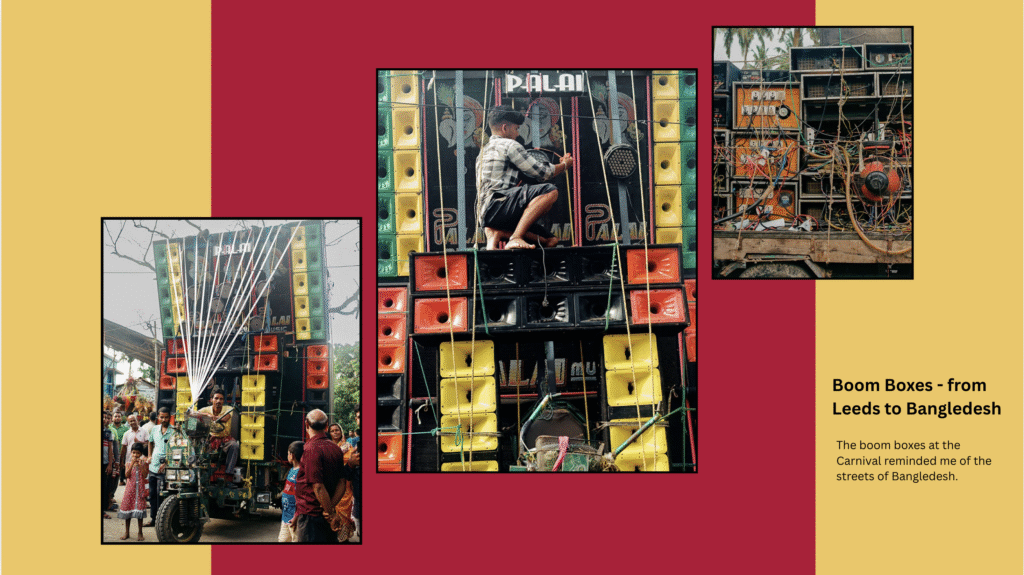
As the day turned to night, I found myself outside again, swept into a street party outside Harris. Boom boxes lined the pavements, basslines pulsing into the air.
The energy reminded me of images I’d once of carnivals in Bangladesh – whole streets alive, spilling over with sound and movement. And just as easily, it echoed the street parties of Jamaica, where music spills into every corner, claiming the night as its own.
It struck me how culture has no fixed borders. Music, food, laughter – they travel, they adapt, they belong to us all.
Belonging, I realised, isn’t tied down. It moves like music through a crowd or voices across a street. It is Leeds and Bangladesh and Punjab, both Harehills and Roundhay, Jamaica and the boom of street parties, festival fields and the innocence of childhood play.
Closing Reflection
What I noticed this weekend, across cinema screens and festival fields, across food stalls and childhood streets, is that belonging is rarely fixed.
It doesn’t live in one postcode, or one class, or one role. It happens in moments – the shift from hesitance to connection, from suspicion to joy.
We spend so much time searching for belonging in one perfect place. In one person. In one family. In one religion. In one identity. In one community. We long for that single anchor that will tell us: this is who I am, this is where I fit.
But I’ve come to realise – belonging rarely works that way. To place the whole weight of ourselves in just one corner of life can leave us confined, unseen, or even broken-hearted when that space cannot hold everything we are.
One person cannot carry the fullness of our belonging. One family cannot contain it. One religion, one culture, one community will never tell the whole story of who we are.
True belonging is more fluid, more layered. It stretches across moments and places – a conversation with a stranger, the taste of a dish that reminds you of home, the rhythm of a song that carries you back to childhood, the quiet understanding in another neurodivergent soul who simply gets it. Who gets you.
And belonging moves across borders. It is Leeds and Bangladesh. Both Harehills and Roundhay. Jamaica and the boom of street parties. Festival fields and the innocence of childhood play. Belonging is not rooted in one soil – it flows, it travels, it transforms.
Perhaps that’s why the words of Maya Angelou ring so true. I was introduced to her writings by a fellow colleague
“You only are free when you realise you belong no place – you belong every place – no place at all.”
Angelou’s wisdom reminds us that belonging is not a destination, but a freedom we carry within us.
Researcher and storyteller Brené Brown, known for her work on shame, trauma, vulnerability, courage, and connection, expands on this by saying:
“True belonging is the spiritual practice of believing in and belonging to yourself so deeply that you can share your most authentic self with the world and find sacredness in both being a part of something and standing alone in the wilderness.”
Together, their words remind us that belonging is both everywhere and nowhere, both communal and deeply personal.
To understand this is to embrace the paradox: that our truest belonging is found when we stop chasing it in one fixed place, and instead live it – in colour, in community, and most of all, in connection with ourselves.
Epilogue …
Belonging is not one door we enter,
but many windows we pass through.
It is the laughter of strangers,
the rhythm of music,
the memory of washing lines in the wind.
Everywhere. Nowhere.
And always, within.
Disclosure: this piece is edited using Chat GPT to find references for Maya Angelou