
- Why I Created the R.U.D Process® and What’s My State?®
- My Experience of Freeze
- The Demands Hidden Inside “How Do You Feel?”
- Why I Created the R.U.D Process®
- Why I Created What’s My State?®
- More Than Moving Towards a “Good” State
- How the Two Resources Connect
- Children Do Not Experience Their Nervous Systems in Isolation
- Taking This Work to the Polyvagal Institute Gathering
- Continue Exploring
Section 1
Why I Created the R.U.D Process® and What’s My State?®
A gentle note before reading: this article contains brief, non-graphic references to childhood physical punishment, the sudden death of a parent and bereavement by suicide.
From 22–24 September 2026, I will be at the Polyvagal Institute International Gathering in Sitges, Barcelona, presenting two research posters about resources I created through lived experience, clinical practice and my work with neurodivergent people and families.
The official theme of this year’s Gathering is Navigating Conflict with a Resilient Nervous System.
“Resilient” is not a word I use often in my own work; I tend to speak about steadiness, capacity, protection and support.
However, the Gathering’s focus on nervous systems and conflict feels particularly meaningful because both of my posters explore what can happen when our internal experience is difficult to recognise, understand or communicate – especially during moments of stress, conflict or disconnection.
The first poster presents the R.U.D Process® — Recognise, Unravel and Understand, Diffuse and Develop.
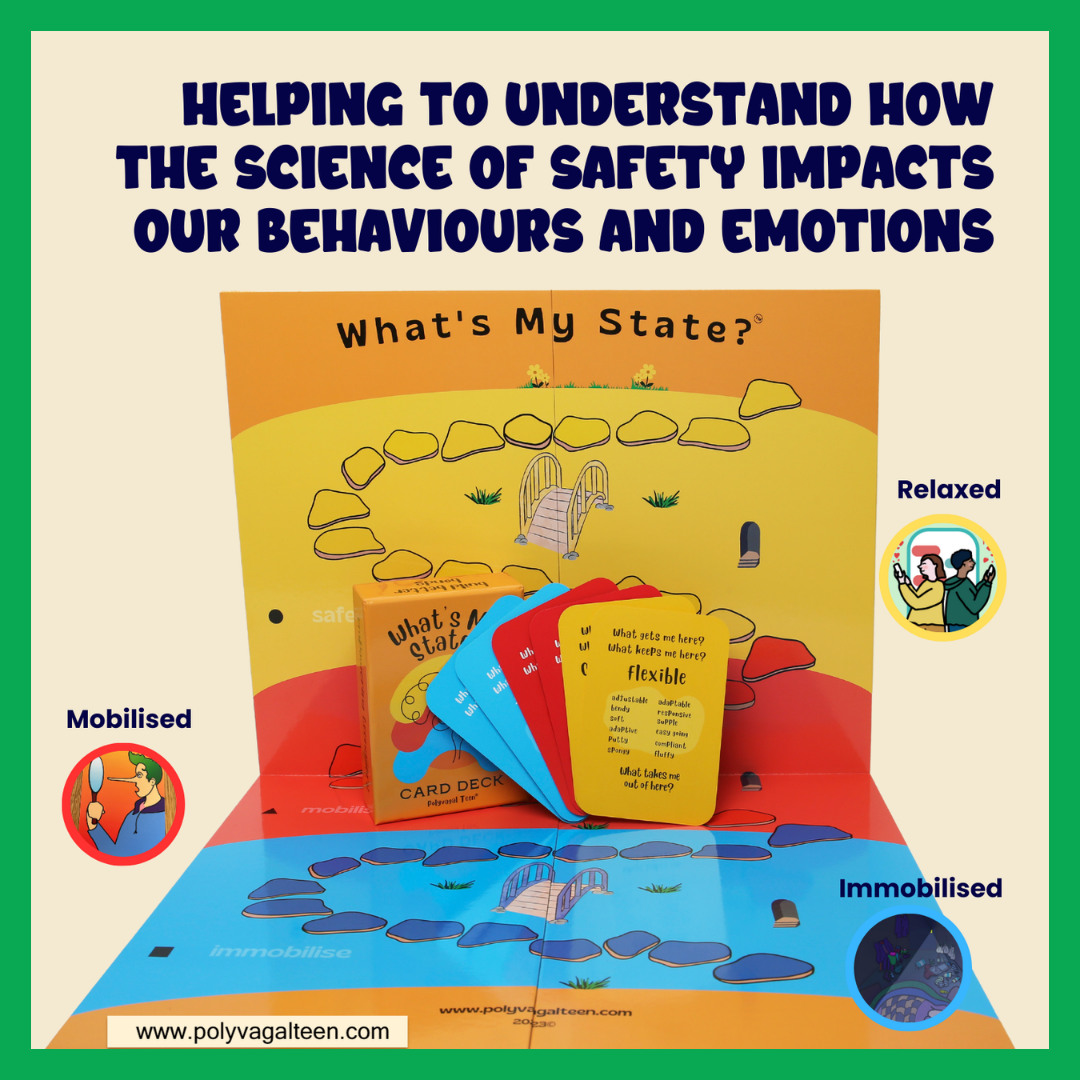
The second presents What’s My State?®, a polyvagal-informed, somatic state-mapping resource created for children, teenagers and families.
The two resources can be used independently, but they developed from the same question:
How can we begin to understand what is happening when the perfect words are not available?
For me, that question is both professional and deeply personal.
Section 2
My Experience of Freeze
I can trace my experience of freeze back to childhood.
I remember being frightened. I was shouted at frequently, and physical punishment was used unpredictably. I did not always know what response was coming, what might trigger it or whether trying to explain myself would make the situation worse.
My childhood also included a sudden and profound bereavement. When I was 13, my father died unexpectedly, and I was the person who discovered that he had died. I do not share this for shock, or to suggest that one experience explains everything. I share it because it formed part of the context in which my nervous system came to anticipate that life could change without warning.
Silence did not mean that I had nothing to say or that nothing was happening inside me. I was watching, listening and trying to work out what would keep me safe. Becoming quiet, still or less visible was sometimes the only response available to me.
At the time, I did not have language for this. I only knew that words could disappear precisely when I needed them most. My internal experience could be intense while very little was visible externally.
In adulthood, it sometimes felt as though part of the pattern repeated. This year marks 20 years since my then-partner died by suicide. The circumstances were different, but another sudden loss touched something familiar: shock, unanswered questions and the knowledge that life could change without warning.
I do not believe that our lives are destined to repeat themselves, or that these experiences provide one simple explanation for who I became. They are, however, part of the context in which my protective responses developed—and part of why I became so interested in the space between what happens inside us and what we are able to communicate to other people.
Although freezing and immobility had been recognised long before Polyvagal Theory, Dr Stephen Porges’s work offered me a framework for thinking about immobilisation and shutdown as nervous-system responses to perceived threat. It helped me understand my silence differently: not as weakness, stubbornness or an absence of feeling, but as protection.
That understanding also helped me recognise something important within my clinical work:
Children and adults cannot always explain what is happening while they are experiencing it.
Sometimes the words come later. Sometimes they arrive through movement, play, images or objects. Sometimes they remain difficult to access even when the experience itself is very real.
This became part of the reason I created both the R.U.D Process® and What’s My State?®.
Section 3
The Demands Hidden Inside “How Do You Feel?”
“How do you feel?” can sound like a simple and caring question.
But answering it may require somebody to:
- notice what is happening inside their body;
- distinguish one sensation or emotion from another;
- understand what may have triggered it;
- find language for the experience;
- organise those words into an answer;
- decide whether it feels safe to share that answer;
- communicate while their nervous system has enough capacity to do so.
That is a considerable demand.
Some neurodivergent people experience differences in interoception—the noticing and interpretation of internal bodily signals. Some experience alexithymia, which can make identifying or describing emotions more difficult.
These experiences vary between individuals and should not be treated as universal features of autism, ADHD or any other neurotype; research also cautions against assuming that interoceptive differences can be explained by autism alone. (Shah et al., 2018)
A person may notice:
- tightness in their chest;
- an urge to leave;
- heaviness or numbness;
- heat rising through their body;
- an inability to stay still;
- words disappearing;
- the same conversation replaying repeatedly;
- a strong sense that something is wrong.
They may recognise the distress before they understand the emotion or need beneath it.
A child may therefore answer “I don’t know.”
They may shrug, change the subject, become silly, hide, lash out, leave the room or stop responding.
These behaviours do not tell us everything about what the child is experiencing. But they give us somewhere to begin becoming curious.
Section 4
Why I Created the R.U.D Process®
I created the R.U.D Process® as I believe self-awareness can be a catalyst for change through repeatedly noticing micro-moments.
It can be used across many different situations: relationships, family conflict, education, work, rejection sensitivity or any moment in which reactions begin to feel confusing or overwhelming.
The process has three stages:
R – Recognise
We begin by noticing the Four S’s:
- Situation: What happened?
- State: What state am I in?
- Story: What meaning am I making?
- Sensation: What am I noticing in my body?
At this stage, we are gathering information rather than trying to solve the experience.
This distinction matters. When somebody is overwhelmed, attempts to immediately analyse, challenge or fix their response may create another demand. Recognising allows us to pause long enough to notice that the external event, the nervous-system state, the story we are making and the sensations in the body are connected—but are not necessarily the same thing.
U – Unravel and Understand
We then explore:
- What got me there?
- What kept me there?
- What helps me move from there?
This is where we can become curious about history, context, relationships and repeated patterns.
We might ask whether we are searching social media or another person’s behaviour for an answer. We might notice that other people’s interpretations have begun to shape our own. We can begin separating what happened, what we were told and what we have inferred.
D – Diffuse and Develop
The final stage is not about controlling the nervous system or forcing ourselves to become calm.
It is about turning down the intensity where possible and developing a steadier response. That may involve a boundary, a direct request, movement, sensory support, time to process, a repairing conversation or deciding not to engage until greater capacity is available.
The aim is not one dramatic transformation. It is noticing the possibility of a different response within the next micro-moment.
Section 5
Why I Created What’s My State?®
The R.U.D Process® offers a structure for awareness and reflection. But I also wanted a practical way for children, teenagers and families to make nervous-system experiences visible and physical.
Many emotional-literacy resources begin with language. They may use lists of emotion words, facial expressions or questions that ask a child to explain what they feel.
These resources can be helpful, but they may not be accessible to everybody.
- What if the child does not yet have the word?
- What if the word changes depending on the context?
- What if the body knows before the conscious mind does?
What if speaking feels too exposing – or the child communicates more easily through movement, drawing, play, AAC, symbols or objects?
The What’s My State?® Board and Cards were created to offer another starting point.
The board makes movement between broad nervous-system states visible. The accompanying cards explore possible bodily cues, behaviours, barriers and sources of support.
Children and adults can use figures, stones, buttons or personally meaningful objects and physically place or move them across the board.
This allows somebody to explore an internal experience externally.
A child does not have to begin by saying:
“I feel overwhelmed because the uncertainty activated a protective response.”
They might begin by placing a figure somewhere on the board.
They might show that they were in one place before school and somewhere else after entering the classroom.
They might position family members in different states during an argument.
They might choose an object because it carries a personal meaning that no standard emotion card could have anticipated.
The movement itself becomes part of the communication.
Section 6
More Than Moving Towards a “Good” State
What’s My State?® is not intended to divide nervous-system experiences into good and bad states.
Mobilisation can support action, protest, energy and protection. Immobilisation can conserve resources when something feels inescapable. Connection and steadiness cannot be demanded, performed or permanently maintained.
The purpose is not to move a child towards a preferred colour as quickly as possible. Nor is nervous-system language meant to make children easier for adults to manage.
Instead, the tools invite questions such as:
- Where might you be right now?
- What lets you know?
- Where were you before this happened?
- What seemed to move you?
- Is anything keeping you stuck here?
- What might offer a little more capacity?
- Who could support you?
- What do the adults around you need to notice about their own states?
The child is not being asked to regulate in isolation while the environment remains unchanged.
The family, school or practitioner also has something to learn.
Section 7
How the Two Resources Connect
What’s My State?® and the R.U.D Process® share an underlying purpose: making what is happening beneath the surface easier to notice.
The What’s My State?® tools make nervous-system experiences visual, physical and relational. The R.U.D Process® offers a structure for exploring what has been noticed and considering what might happen next.
A child or family might use the board to map a difficult interaction:
Parent stressed → child tired → parent becomes louder → child shuts down → parent feels guilty → both withdraw.
The board can help externalise the sequence. Rather than identifying one person as the problem, the family can see how each response affected what happened next.
The R.U.D Process® can then support reflection:
Recognise
- What was the situation?
- What was the state of the nervous sytem?
- What story did each person make about the other’s behaviour?
- What sensations did they notice?
Unravel and Understand
- What got each person there?
- What kept the cycle moving?
- Did anybody need more time, information, space or reassurance?
- Were earlier experiences being touched by the present moment?
Diffuse and Develop
- Where might one small pause have changed the sequence?
- What could the adult do differently next time?
- What form of communication is accessible to the child?
- What might repair look like now?
The purpose is not to prove whose account is correct. It is to create enough shared understanding for greater choice, accountability and repair.
Section 8
Children Do Not Experience Their Nervous Systems in Isolation
Children develop within relationships, families, schools, cultures and communities.
Their experiences may be shaped by neurodivergence, disability, poverty, racism, migration, faith, cultural expectations, blended-family relationships and patterns carried across generations.
A child of colour may have their fear interpreted as aggression. A mixed-heritage child may move between different cultural expectations and experiences of belonging. A child within a blended family may adapt to different homes, rules, relationships and emotional languages. A parent may respond to a present-day conflict through protective patterns formed within their own childhood.
A nervous-system-informed approach should help us become more curious about these contexts – not remove them from the conversation.
It must not turn discrimination into an individual regulation problem or ask children to become more tolerant of environments that repeatedly harm them.
It should help us ask:
What might this child’s nervous system be communicating – and what is happening within the relationships and wider systems around them?
These questions will be explored more fully in the next articles in this series.
Section 9
Taking This Work to the Polyvagal Institute Gathering
Presenting these two research posters at the 2026 Polyvagal Institute International Gathering feels like an important moment for me.
The Gathering brings together work around conflict, connection, embodied practice, culture, repair and relational safety.
I am over the moon to contribute resources created from the meeting point between my lived experience, therapeutic practice, creativity and work with neurodivergent people.
I am not presenting the R.U.D Process® or What’s My State?® as ways to remove every difficult response or eliminate conflict.
Conflict is part of human relationships. Protective states are part of being human.
My hope is that these resources can make patterns more visible, offer more accessible routes into reflection and create micro-moments in which a different response or repair becomes possible.
For the child who cannot yet name what is happening.
For the teenager who repeatedly says, “I don’t know.”
For the parent whose own nervous system is activated.
For the family caught in a cycle in which everybody feels misunderstood.
For the adult who, like me, spent years believing that freeze meant weakness, being less than – rather than protection.
Perhaps understanding does not always begin with the perfect words.
Sometimes it begins with a sensation, a movement, an image, an object – or one micro-moment of noticing:
Something is happening here. Can we become curious about it together?
Section 10
Continue Exploring
This is the first article in my What’s My State?®: The Nervous Systems We Bring Into Family Life series.
The next article, When Nervous Systems Collide at Home, will explore how stress travels through family relationships, how protective responses activate one another and how we can move from individual blame towards shared understanding and repair.
The third article, Before We Call It Behaviour, will consider children of colour, mixed-heritage identity, childhood trauma and whose nervous-system state gets misunderstood.
You can:
- explore the What’s My State?® Toolbag;
- download the free R.U.D Process® resource: [add link];
- bookmark my conference updates page: [add link];
- join the mailing list below so you do not miss the next article.
