

Masculinity, Language, and the Stories We Tell Boys
By Yasmin Shaheen-Zaffar
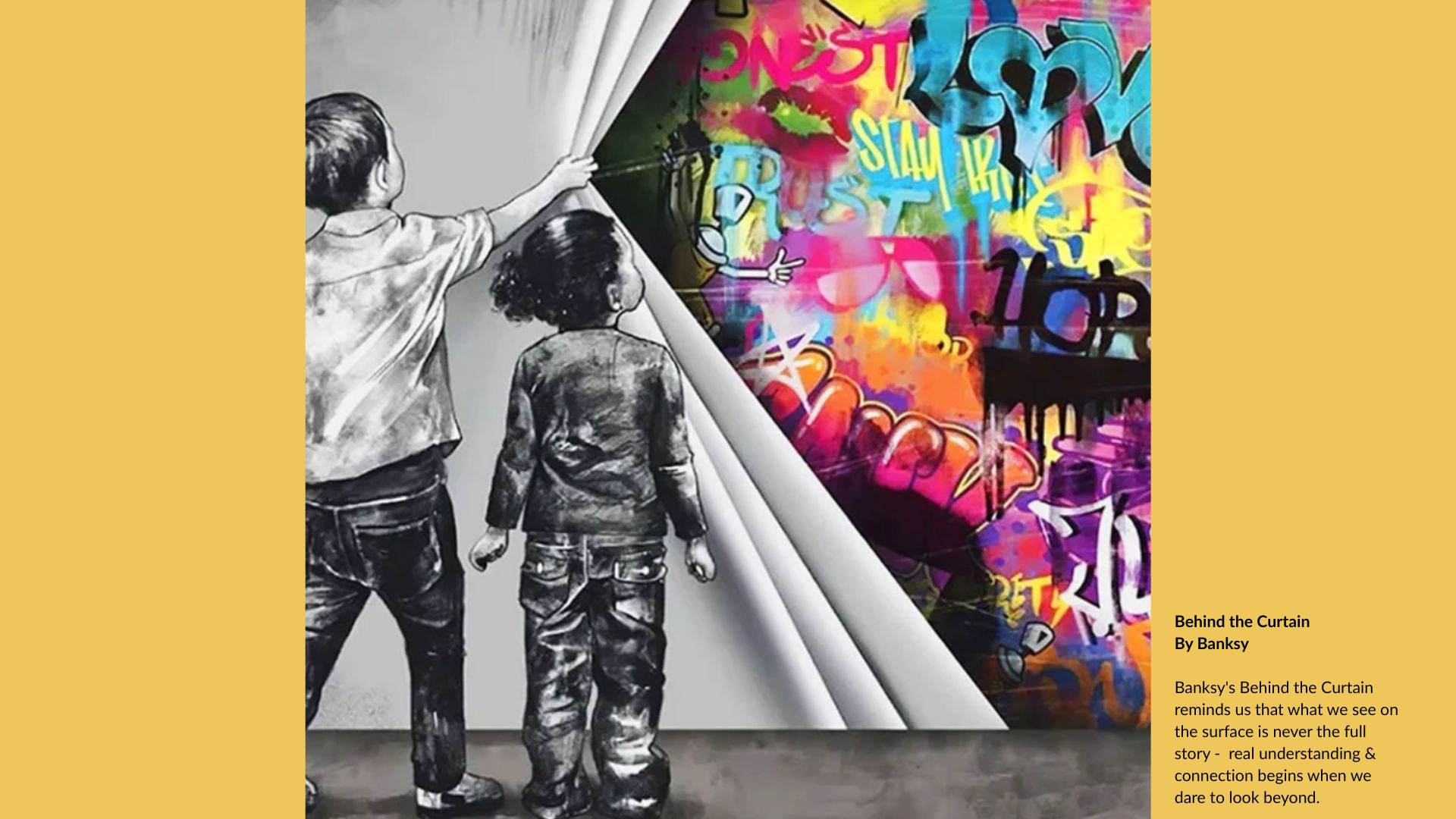
(This writing is accompanied by the artworks Three Boys Three Boys by Rozemarlin Borkent and Behind the Curtain by Banksy. Together, they reflect the beauty, hidden realities, and complexities of growing up masculine in today’s world.)
We hear a lot about toxic masculinity these days.
And I completely understand why the term was created.
It was – and still is – important to have language that calls out the real harm caused by domination, violence, and the suppression of vulnerability.
In the right context – especially when harm has been done – naming toxic patterns is necessary. Crucial.
Language gives us the power to confront what needs to change.
But every time I hear the overuse of the phrase toxic masculinity, I feel a physical jolt deep in my of body. Something flinches inside me.And I can’t help but wonder:
What if my daughter grew up constantly hearing the phrase “toxic femininity” attached to her identity?
Would she begin to believe that femininity itself – not just certain behaviors – was toxic?
What would that do to her sense of self, her relationship with shame, and her ability to feel safe in who she is?
How would that shape her relationship with herself? With boys and men?
With shame? With blame?
Because words matter.
Language matters.
Especially when children are still piecing together who they are and how they belong.
We know how important it is to respect someone’s pronouns – because the words we use tell people, I see you. I respect you. I believe you.
Surely, then, the labels we give boys and masculine youth matter too?
Surely they deserve words that lift them up, not ones that weigh them down.
The Danger With Overusing “Toxic Masculinity”
When the term toxic masculinity is used with precision – to describe patterns of harm like domination, suppression of vulnerability, or violence – it serves a crucial role.
It helps us recognise and name behaviors that have caused suffering, both to others and to the boys themselves.
But when the term is used casually, broadly, or without care – when masculinity itself is treated as inherently toxic – the cost is profound.
Today’s boys are growing up in a world where many already feel disconnected, invisible, and unsure of their place.
The Lost Boys report (March 2025) paints a stark picture:
Boys are falling behind academically from the earliest stages of education.
They are more likely to experience mental health struggles, but less likely to access emotional support.
One in five children grows up without a father figure at home.*
Many boys seek belonging, mentorship, and models of adulthood in online spaces – some of which offer power without compassion.
When boys already feel unseen and misunderstood, constantly hearing that masculinity is “toxic” can push them further into shame, isolation, and defensiveness. Or worse, it can push them into communities that weaponise their pain rather than heal it.
We cannot ask boys to heal if the main message they hear is that they are the disease.
*This is absolutely not an attack on single mothers. I have been a single mother myself. I grew up without a father from age 13. This is not about blaming families; it’s about recognising that all young people – regardless of family structure – need access to positive, nurturing role models. All children need to see examples of strength, care, and emotional leadership they can aspire to.
Word Creep: When Language Expands Too Far
In 2016, psychologist Nick Haslam introduced the idea of concept creep – the observation that words related to harm, suffering, and pathology have expanded dramatically over time, often in ways that dilute their original meaning.
Haslam identified two ways this happens:
Vertical creep – when serious terms are applied to milder cases. (For example, calling everyday setbacks “trauma.” (which actually they can be .. but that’s for another article)
Horizontal creep – when terms stretch sideways to cover new, unrelated situations. (For example, labeling any interpersonal conflict as “bullying.”)
At first glance, expanding language can seem like progress.
It brings visibility to forms of harm that were once ignored.
It allows us to name emotional wounds that aren’t visible to the eye.
But there is a cost when language expands without precision.
When powerful terms like “trauma,” “abuse,” or “toxic masculinity” are used too broadly, we risk:
Blurring vital distinctions between serious harm and ordinary challenges.
Embedding shame in young people still trying to figure out who they are.
This is especially dangerous for boys, who are already grappling with cultural messages about what it means to be strong, to belong, and to be worthy.
When masculinity itself is labeled as toxic – rather than targeting specific harmful behaviours – boys who are tender, sensitive, neurodivergent, or non-traditional can internalise the belief that there is something fundamentally wrong with them.
And this harm doesn’t only apply to cisgender boys.
Masculinity – like femininity – is not the property of one gender.
It’s a fluid, evolving set of energies, identities, and cultural messages.
This conversation speaks to anyone navigating expectations around masculinity:
Trans boys, who often face unique pressures to “prove” their manhood.
Nonbinary teens, who may embrace masculine traits but feel excluded from narrow definitions.
Neurodivergent youth, who often don’t fit traditional masculine scripts of stoicism or dominance.
When we use broad labels carelessly, we risk wounding not just cis boys, but anyone on the journey of becoming – anyone trying to find a way to embody strength, sensitivity, leadership, and care without shame.
As Haslam warns, concept creep can “inflate harm, undermine resilience, and blur moral boundaries.”
Language meant to heal can, if misused, become a source of harm itself.
“Words build worlds. And the worlds we build for our children today will shape the world we all live in tomorrow”.
Yasmin Shaheen-Zaffar
Boys or masculine youth are not the problem.
Masculinity isn’t toxic by default.
The problem lies in the narrow, rigid versions of masculinity that tell boys they must dominate to have worth, stay silent to stay strong, or disconnect from tenderness to belong.
True masculinity – like true humanity – is wide enough to hold strength and softness, bravery and vulnerability, leadership and deep care.Boys don’t need to be shamed out of who they are; they need to be invited into all of who they are.
This is why we need better stories – stories that affirm the full humanity of boys and masculine youth, rather than shrinking them into shame or stereotypes.
What Boys (and Masculine Youth) Need to Hear Instead
This isn’t about denying the existence of harmful behaviours or not holding those who harm accountable.
It’s about refusing to let shame be the soil in which young people’s identities are rooted.
Boys – and anyone who identifies with masculinity – need stories that affirm their full humanity.
They need to know that strength does not mean domination, that leadership can coexist with tenderness, and that emotional honesty is not weakness – it is courage.
That’s why I often talk about feminine masculinity.
Not to feminise boys.
Not to erase ambition, fire, or drive.
But to expand masculinity to include care, intuition, empathy, emotional intelligence, and nurturance – qualities that are human, not gendered.
When we allow all young people to access the full spectrum of who they are, they don’t become less masculine – they become more whole.
A New Vision for Boys and Masculine Youth
I believe in a masculinity that doesn’t require domination to feel powerful.
I believe in a boyhood where crying and care is a language, not a weakness.
I believe in teaching boys and masculine youth that protection doesn’t mean violence, and leadership doesn’t mean silence.
The world is not asking boys to become less.
It’s asking them to become more whole.
Feminine masculinity isn’t an attack on manhood – it’s an invitation back to humanity.
“Our children – all of them – deserve nothing less.”
Before I close, I want to acknowledge the artworks accompanying this piece: Three Boys Three Boys by Rozemarlin Borkent, and Behind the Curtain by Banksy.
Rozemarlin’s work captures the beauty, dignity, and diversity I believe every boy deserves to see reflected.
Banksy’s Behind the Curtain serves as a powerful metaphor for exploring hidden realities, challenging the surface stories we are told, and seeking deeper truths. It reminds us that behind every stereotype, every cultural script about masculinity, there is a much richer, more vulnerable human experience waiting to be seen.
I want to be clear – this writing speaks to boys and masculine youth of all backgrounds. It is not a message limited to boys of colour, or to any one community. It is an invitation to honour the full, complex, expansive humanity of everyone navigating masculinity today.
Thank you to both artists for creating such powerful, moving work that helps bring these deeper layers into view.
Final Thoughts
If you’re raising, teaching, or caring for boys and masculine youth, know this:
They are paying attention even when it doesn’t seem like it.
The way we speak about what it means to be masculine shapes how they see themselves.
Boys are not the problem.
They don’t need to be blamed for the struggles around them – they need better stories about who they can become.
When we show young people that being kind, caring, intuitive, and strong are all part of their identity, we give them permission to be their full selves – not just the tough parts.
Because when young people feel safe to be everything they are – not just what they think they have to be – everyone wins.
It starts with a word.
Not “toxic.”
Not “broken.”
Not “fixing.”
But brave.
Kind.
Growing.
“It starts with a story”
If we tell young boys they are dangerous, they will shrink or harden.
If we tell young boys they are becoming, they will rise.
Which story will you tell?
Every boy carries both a light that deserves to be seen and a hidden story waiting to be understood.
Rozemarlin Borkent’s Three Boys Three Boys and Banksy’s Behind the Curtain can remind us: if we look with dignity, if we look beyond the surface, we can help them rise whole. ( and yes a written piece about the term Toxic Femininity is on its way in the next few weeks).
