


Boys, Sextortion, and the Price of Shame:
In March 2025, the Centre for Social Justice published The Lost Boys: State of the Nation, a report detailing the crisis facing boys and young men in the UK. Among many troubling statistics, one figure for me stood out. It kinda shook me:
91% of sextortion victims are boys, most between the ages of 14 and 17.
These boys aren’t necessary being lured into danger by shadowy figures on the dark web. Instead, they’re being groomed in plain sight – on platforms like Instagram, TikTok, Snapchat, and even Facebook.
Many of these grooming tactics are subtle. A slightly low-key flirty video. A glimpse of her bed with her teddy bears (this is over 18 year old adult content creators).
A DM that seems personal … “pov how’s your fam?”. A link to content … “only for YOU exclusively … especially … shhhhh don’t tell anyone!” or a simple “thinking of you x”.
Often, the person behind the account isn’t a peer – it’s an adult content creator or an organised sextortion ring targeting vulnerable young people.
And it’s all designed to emotionally funnel boys and young men towards paid content, strip clubs, escorts, drugs or explicit exchanges that can quickly spiral into blackmail.
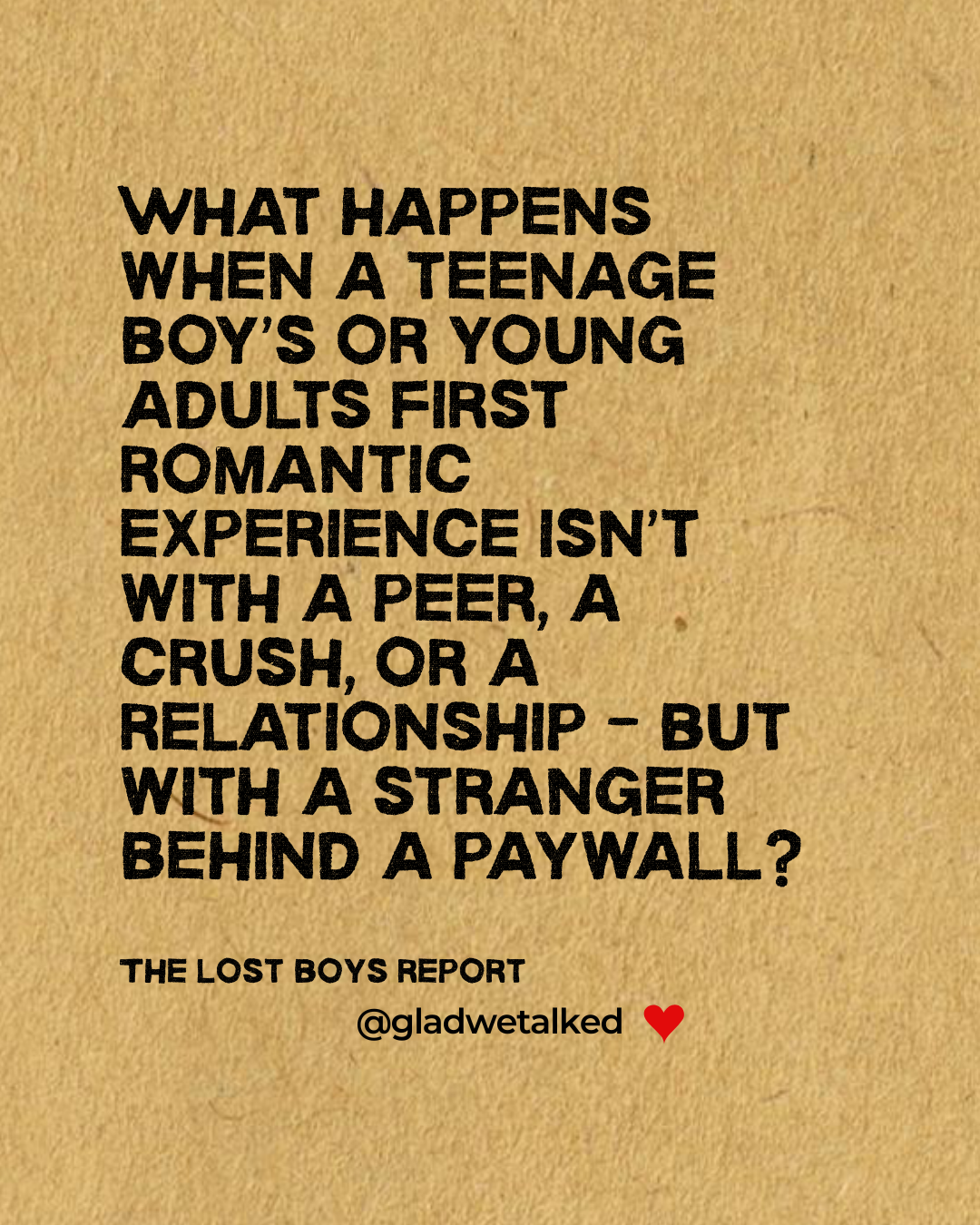
For some boys or young men , this is their first experience of romantic or sexual attention. And it comes with a cost.
What Message Does That Send?
What are we teaching a generation of boys and young men if their first taste of connection is transactional?
If a boy or young man learns early on that to be seen, to be wanted, or to be valued, he must pay- or worse, expose himself – what happens to his sense of self-worth?
What happens when he makes a mistake and feels too ashamed to tell anyone? How will that impact his future relationships?
Let’s also remember eighteen year olds are “emerging adults”. This isn’t about infatising them – its about neuroscience and brain development.
What is an Emerging Adult?
An emerging adult is typically someone between the ages of 18 and 25/29 ish, It’s a unique period between adolescence and full adulthood – a kind of “in-between” phase.
The term was coined by psychologist Jeffrey Arnett to describe how this stage has become more defined in modern life.
During these years, many young people are no longer teens, but they also haven’t settled into all the roles and responsibilities often associated with full adulthood.
Common traits of emerging adulthood include:
Identity exploration – figuring out who they are in relationships, work, and beliefs
Instability – frequent changes in jobs, homes, friendships, and goals
Self-focus – time spent developing independence and personal growth
Feeling in-between – not quite a teen, not quite a fully-fledged adult – but legally an adult.
A sense of possibility – optimism, hope, and imagining different futures
It’s a time of both freedom and uncertainty, when many are working out what kind of life they want to build.
Brain Development in Emerging Adults
During this time, the prefrontal cortex – the part of the brain responsible for decision-making, impulse control, and emotional regulation – is still developing. It doesn’t fully mature until around age 25 (sometimes later).
This part of the brain helps with:
Planning and prioritising
Managing emotions
Weighing consequences
Regulating impulses
Making thoughtful decisions
Because of this ongoing development, emerging adults may:
React emotionally rather than logically.
Be more impulsive or take greater risks.
Struggle to plan long-term or see future consequences clearly
This isn’t a flaw – it’s part of normal brain development. It means that this age group can benefit greatly from guidance, co-regulation, and environments that support emotional and cognitive growth.
And what if that boy or young man is neurodivergent?
For boys who are impulsive, struggle with friendships and loneliness, or have difficulty reading between the lines – traits common in those with ADHD or who are Autistic – the risk is even greater. These young people are more likely to misread intent, fall into grooming traps, and feel deep shame when they realise what has happened.
But shame is silent ….
And as the Lost Boys report points out, boys are less likely to disclose what has happened to them. They stay quiet, they hide, and in tragic cases, they harm themselves.
Girls and the ‘Feet Pic’ Economy:
While boys are being targeted for their need to feel seen, girls are being celebrated for monetising their bodies before they’ve even fully understood boundaries or consent.
On TikTok and Instagram, it’s become increasingly common for girls as young as 13 or 14 to joke – sometimes seriously – about selling feet pics or creating suggestive content for older men so they can “get their nails done”.
Brands and influencers glamorise the idea of “making money easily” through attention.
It’s not difficult to find Facebook and Instagram posts on your feed of women twerking to sell bikinis to soundtracks proclaiming ‘sex sells.’ ( And yes it certainly does!).
And for girls growing up in a hypersexualised, performative culture? it can feel empowering – at first.
But what’s the long-term impact when a girl’s first tween experience of economic value is tied to how she looks or how well she can twerk rather than what she thinks, feels, or dreams of?
Feet pics may seem harmless, but they are the start of a slippery slope of self-objectification, where identity becomes performance and worth becomes tied to validation from others.
And again, if a girl is neurodivergent – especially if appeasement is her coping strategy, rejection-sensitive, been abused, had trauma, seeks external validation due to her needs not being met at home or craves praise – this kind of attention can feel like belonging. Until it isn’t.
The Hidden Curriculum No One Talks About:
We often worry about what our kids are watching, what content they’re consuming, what apps they’re using.
But we rarely stop to ask:
 What are they learning about connection?
What are they absorbing about intimacy, power, and their bodies?
What are we unconsciously teaching them about who they need to be to feel accepted or loved?
There is a hidden curriculum running 24/7 in the background of every screen – and it is teaching children about value, shame, and survival far more powerfully than any school or family talk.
The Solution Isn’t Fear. It’s Communication:
This isn’t a post about banning social media.
And it’s not a post about banning adult content creators, strippers and escorts – many of whom are navigating their own boundaries, stories, and businesses with care and agency. They have just as much right to be here in society doing their business.
This is a post about asking harder questions of the platforms that allow children and teens to be funneled into unsafe spaces.
It’s about ethical marketing – especially when minors are just one click away from being targeted. It’s about those groomers and drug peddlers that do not use ethical marketing strategies.
Because let’s face the reality – there’s even space yes for dealers in society. Ethical drug dealers who don’t sell to children or those in recovery. Is that a conversation that needs opening?
And it’s about holding social media algorithms accountable when they’re designed to profit from young people’s attention, even at the cost of their well-being. And in the most tragic cases – their lives.
But most of all, it’s about connection.
Because the internet is raising our kids, whether we like it or not. And if we’re not talking to them about these things, someone else – often with less care and more agenda – already is.
That’s why I created Glad We Talked™ and the Polyvagal Teen® programs and resource kits.
Not to control what young people do online, but to support homes in building the kind of relationship where a child feels safe saying:
- “Something weird happened online.”
- “I made a mistake.”
- “Can we talk?”
The only real antidote to online manipulation and shame is real-world connection and conversation. And for that, we need more than “just talk to your kids” – we need sharing of knowledge that make’s it easier to connect – without judgment. Without shame. Without blame.
Our tools are:
 Neurodivergent-affirming
 Rooted in nervous system awareness
 Built to strengthen trust, not fear
 Adaptable for tricky, emotional topics like sex, identity, rejection, and self-worth
Because prevention doesn’t start with panic.
It starts with presence.
And presence opens the door to connection – the kind that keeps our kids steady, even in a chaotic world.
A Question to Ponder:
And what about when these boys grow up? If their first encounters with intimacy are transactions behind a screen, what does it mean for their future relationships? Are they at risk of turning to online platforms instead of developing real-life connections?
These questions are vital today to ensure that our approach to prevention and support evolves as our understanding deepens.
How do these early experiences shape their views on women? There is a concern that without the right guidance, such experiences could foster a deep-seated resentment towards women, potentially drawing young men towards extreme, misogynistic ideologies.
It’s crucial to clarify that while understanding these trajectories is essential, it in no way justifies any form of violence or disrespect towards others.
Our goal is to intercept these pathways with education, understanding, compassion, connection and supportive conversations that affirm healthy, respectful relationships across all spectrums of life.
By addressing these challenges head-on, and providing spaces for open dialogue, we can help guide our young people towards more positive and fulfilling interpersonal relationships. We must explore these dynamics deeply to prevent harmful patterns from taking root and to foster a generation that values empathy, respect, and genuine connection above all.
Want to Take Action?
We’ve created a free resource for parents and caregivers:
 “Talk Before They Scroll: A Parent’s Guide to Sextortion, Screens & Self-Worth”
This downloadable guide includes:
 10 emotional and behavioral red flags to look out for
Conversation openers for boys and girls (including neurodivergent-friendly phrasing)
A breakdown of how “soft grooming” works on platforms like TikTok and IG
 Scripts and tips to avoid shame and build long-term connection
 A special section on “Feet Pics & the Fantasy of Fast Power” for girls]
 Are You a Journalist, Researcher, or Advocate?
If you’re exploring:
- The emotional cost of sextortion for boys
- The rise of early self-objectification in girls
- The impact of neurodivergence on digital vulnerability
- Or how influencer culture is shaping childhood sexuality and identity
I’d love to share what we’ve learned through our work at Glad We Talked™ and Polyvagal Teen®.
Let’s make this visible. Let’s start talking.
